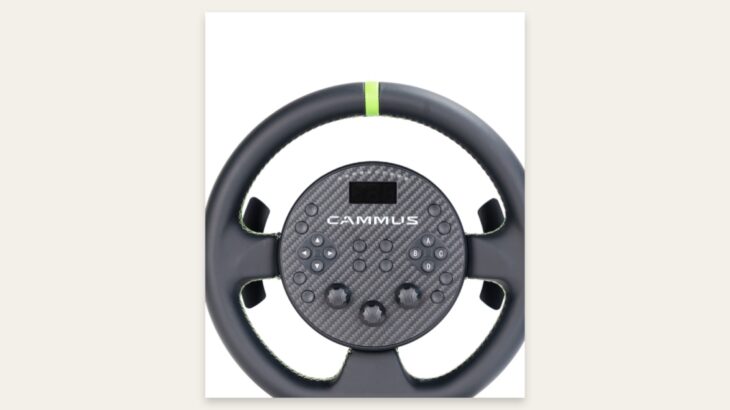
The CAMMUS C5 is a direct-drive (DD) racing wheel that pleasantly overturns the assumption that small hardware must deliver simplified performance. Its biggest advantage is its unusual design, which places the motor on the steering-wheel side, letting you experience authentic DD response in a very small footprint. That said, the included brake feel and supported platforms involve clear compromises. Based on my hands-on test in iRacing with the Ferrari 296 GT3, I explain who the C5 is right for.
- 1. Verdict in 30 Seconds
- 2. The C5’s Defining Feature: Wheel and Motor in One Unit
- 3. Its Biggest Strength in Driving: DD Detail Doesn’t Disappear Despite Its Size
- 4. The Included Pedals Split Opinion Between Throttle and Brake
- 5. What You Should Always Check Before Setting It Up
- 6. Who It Is—and Isn’t—For
- 7. Final Verdict
- 8. Supporting Video
- 9. Read Next
Verdict in 30 Seconds
The most important point in my assessment of the C5 is that this is not merely a budget bundle: the steering wheel delivers the fine detail you expect from a DD unit. Kerb vibrations, the feeling of the tires gripping the surface, and the moment torque builds all came through more directly than on gear- or belt-driven wheels. It is not designed to compete with higher-end DD bases on outright force, but in actual driving I could clearly feel the response speed and road detail I need.
That makes it a strong option for anyone who cannot fit a large wheelbase on their desk, wants to put their equipment away after use, or is moving to DD for the first time on PC. On the other hand, if you want a heavy, real-car-like brake, interchangeable steering wheels, or a fixed rig built around high torque, choosing a higher-end setup from the start will save you from taking a detour.
To explore more options, also see my Assetto Corsa EVO Review: Tire Model, GT7 Comparison, and PS5 Version Potential and Logitech G RS50 Official Specifications Guide: 8 N·m, PS5, and PC Compatibility.
The C5’s Defining Feature: Wheel and Motor in One Unit
A typical DD racing wheel combines a wheelbase mounted to a desk or rig with an interchangeable steering wheel. The C5 greatly simplifies that arrangement by housing the motor in the steering-wheel side. It is compact enough to handle with one hand, with the paddles, switches, and rotary controls all integrated. The included clamp lets you mount it to a desk, and the complete setup—including pedals—does not require much storage space.
My first impression on unboxing it was also different from the cheap feel often associated with lower-priced products. Its metal and carbon-fiber-look components, switch layout, and package of necessary cables and tools make it approachable as a first complete setup. However, the all-in-one design limits expandability, such as swapping to a larger-diameter rim later. You need to choose it with a clear understanding of that trade-off between compactness and expandability.
Its Biggest Strength in Driving: DD Detail Doesn’t Disappear Despite Its Size
Driving at the Nürburgring in iRacing, I found that the fine inputs from kerbs and the response during quick direction changes showed the low-play character unique to DD. What stood out in particular was that it did not merely feel heavy; it communicated the rubbery feeling around the steering lock and the state of the tires through multiple vibrations. It was also easier to follow the transition into understeer through my hands, so I could feel the changes as I approached the limit rather than only noticing once the car had stopped turning.
The steering wheel diameter is somewhat small, and it does not feel the same as a typical GT-car rim. Still, it suits quick inputs, and once I accepted it as closer to a kart-sized wheel, it did not feel particularly unnatural. Rather than the brute force of a high-torque unit, it is a wheel that delivers the information you need in a nimble way.
The Included Pedals Split Opinion Between Throttle and Brake
The throttle has a natural spring feel for a lightweight set, and I had no major issues making fine adjustments to the pedal position. The brake, however, is strongly based on travel rather than pedal force, and the difference in stiffness from the throttle is relatively small. If you are used to a stiff load-cell brake, its initial input will feel light, and you will need practice before you can consistently match your intended braking force.
That said, a light brake is not always a disadvantage. Because it is easier to make quick inputs in a short time, it may suit people who prioritize in-game response speed over real-car replication. The important question is not to assume that it is slow simply because it is not load-cell; it is whether you can consistently reproduce the pedal’s travel position with the sole of your foot. If your priority is real-car practice, consider upgrading the pedals. If lap time is the priority, it is more sensible to first dial in the calibration and input curve.
What You Should Always Check Before Setting It Up
- Whether it is officially recognized by the game and PC environment you plan to use
- Whether your desk thickness is within the included clamp’s mounting range
- Whether you can set up the pedals so they will not move under braking
- Whether you have updated the dedicated software and the unit firmware
- Whether the center position and maximum inputs are correct after calibration
At the time of my video test, I found it difficult to treat this as a product primarily intended for PlayStation, and considered it a PC-focused wheel. Compatibility may change, so check the manufacturer’s latest information when you buy. Relying on unofficial adapters can easily create problems with connection stability and keeping up with updates.
Who It Is—and Isn’t—For
It is suited to PC players who want to minimize the footprint of their setup, people moving from gear- or belt-driven wheels to DD, and anyone who wants to pack their equipment away easily after use. This integrated design also has a clear advantage for the more unusual use case of taking your equipment on trips.
It is not suited to people who want to switch between large-diameter rims, want a high-force brake from the outset, or have a fixed rig to handle strong FFB and want to expand their peripherals within one ecosystem over time.
Final Verdict
The CAMMUS C5 is not an all-purpose, downsized version of a higher-end DD base. However, it has unique value because it lets you bring DD response to a complete setup without the vague steering feel often found in space-saving hardware. My conclusion after driving it is that the wheel itself exceeded my expectations, while the included brake depends on your intended use. If you choose it with a clear understanding of its weaknesses, it is a very interesting entry point into desk-based sim racing.