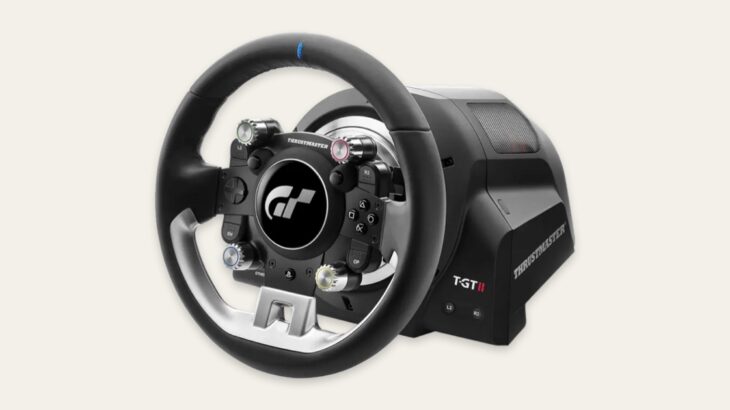
To cut to the chase, even in 2026, the Thrustmaster T-GT II remains a valid choice as the racing wheel that can produce the fastest times in Gran Turismo titles. At around ¥120,000, it sits in the same price bracket as the DD Pro. It uses a belt-drive system, so it falls behind direct-drive racing wheels in outright feel and force feedback detail. But as I found in hands-on testing, it delivered the surprising result of setting faster GT7 times than the Fanatec Podium DD1 (around ¥270,000).
In this article, I organize what I have covered across 36 videos on the Picar Channel about the T-GT II. The focus is on intermediate and advanced drivers whose main titles are GT7 / GT Sport: its light feel, the pedals’ linear control, and what its game-specific design philosophy really means.
- 1. Verdict in 30 Seconds
- 2. What Is the Thrustmaster T-GT II? A Flagship Belt-Drive Wheel
- 3. The Surprising On-Track Result: T-GT II Was Faster Than DD1
- 4. Real-World Feel: Organizing My Experience Across 36 Videos
- 5. Should You Consider Upgrading to the T598?
- 6. Who It Is—and Isn’t—for
- 7. Related Videos
- 8. Frequently Asked Questions
- 9. Read Next
Verdict in 30 Seconds
The conclusion from 36 videos of coverage on the Picar Channel is that the Thrustmaster T-GT II is one of the best answers for chasing the fastest times in GT7 / GT Sport. It loses to the DD Pro / DD1 on the specification sheet, but its nimble controls and the pedals’ linear fore-aft weight-transfer control ultimately make it easier to set quick times. It is the wheel that best demonstrates how “the strongest” does not necessarily mean “the fastest.”
What Is the Thrustmaster T-GT II? A Flagship Belt-Drive Wheel
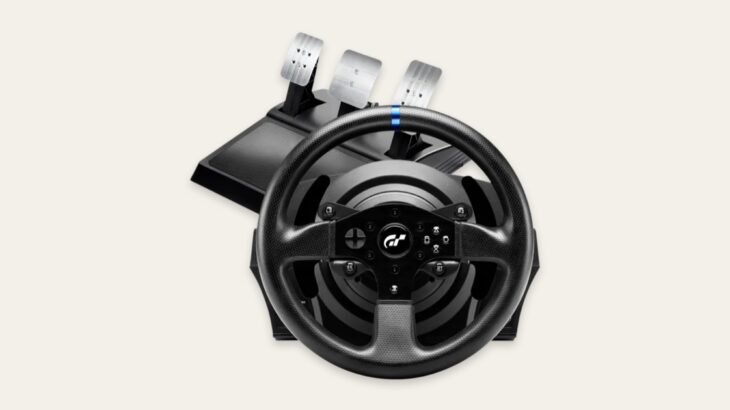
The T-GT II is Thrustmaster’s flagship model, distinguished by a design optimized for the Gran Turismo series.
To explore more options, also see the Thrustmaster T598 Review: DD + High-Frequency Vibration, Official GT7 Support, and T300RS Compatibility Tested Across 7 Videos and Assetto Corsa EVO Review: Tire Model, GT7 Comparison, and the Possibility of a PS5 Version.
Thrustmaster TGT2: Thrustmaster’s flagship TGT2 is also in this price range. It is a belt-drive racing wheel and supports PS5. At around ¥120,000, it is in the same price bracket as the CSL DD Pro. However, compared with the direct-drive CSL DD Pro at the same price point, it is a step behind in response and force feedback accuracy.
— From Picar Channel’s “[Gran Turismo 7] I review all 9 compatible racing wheels”
In other words, on the spec sheet and by drive-system comparison, the T-GT II trails the DD Pro. Yet there is a clear reason it continues to be chosen for Gran Turismo titles, and I examined that reason in the on-track testing covered in the next section.
Key Specifications
| Item | Details |
|---|---|
| Brand | Thrustmaster |
| Series | T-GT (Gran Turismo optimized) |
| Drive system | Belt drive |
| Force feedback | Yes (optimized for Gran Turismo titles) |
| Wheel base price | Approx. ¥120,000 |
| Included pedals | Three pedals (including clutch; potentiometer-based) |
| Supported platforms | PlayStation 5 / PlayStation 4 / PC |
| Partnership | Polyphony Digital (the developer of Gran Turismo) |
The Surprising On-Track Result: T-GT II Was Faster Than DD1
The essence of the T-GT II became clear in my video directly comparing it against the DD1 in a time attack. Under matched conditions, the T-GT II recorded 19.6 seconds, substantially beating the DD1’s 20.4-second time.
Switching to the Thrustmaster T-GT II: surprising feel and lap time. The first thing I felt when I took hold of the T-GT II was how “light” it was. Both the wheel and pedals were extremely light, and I was surprised by how completely different the feel was from Fanatec. It felt almost like using a game controller. The throttle and brake travel were also extremely easy to use, allowing quick and precise inputs with little effort. It was close to the intuitive feeling of controlling a car as though pressing buttons in a game. In particular, it was easier to combine fast brake application with delicate control, making braking techniques possible that had been difficult before.
— From Picar Channel’s “[Gran Turismo 7] The surprising result of comparing the fastest racing wheels in a National Sports Festival time attack”
“It feels like using a game controller” and “you can control the car intuitively” may sound strange to simulation enthusiasts. In practice, though, that can be exactly the key to setting a time in GT7.
Then, when I did a time attack with this T-GT II, I managed to record the astonishing time of 19.6 seconds! It was a major improvement over my Fanatec time. I especially felt that the T-GT II pedals made it much easier to tackle sections requiring delicate inputs, such as the left-hand corner before the tunnel, where you trail off the brakes while turning in. With these pedals, I might be able to bring the time down to 19.3 seconds, or perhaps even into the 18s.
— From the same video
Real-World Feel: Organizing My Experience Across 36 Videos
The Intuitive Control Created by Its “Lightness”
If I had to sum up the T-GT II’s feel in one word, it would be “nimble.” Where Fanatec direct-drive racing wheels feel substantial and strongly car-like, the T-GT II stands out for the lightness that enables fast inputs.
This change in feel also affected the car’s behavior. In particular, I found the vibration through the wheel when understeer occurred—when the car does not turn despite steering input—extremely easy to understand. It made the car’s limit easier to grasp. As a result, I was able to challenge lines that I had not been able to push before.
— From Picar Channel’s “GT7: Fastest Racing Wheel National Sports Festival Time Attack”
The fact that “the vibration during understeer is easy to understand” shows how well Thrustmaster has tuned its force feedback. It lets you read the car’s behavior at the limit directly through the wheel and make decisions about which line to attack.
Linear Pedals Make the “Decisive Difference”
The T-GT II’s real strength also lies in its included pedals. At a glance, hard load-cell pedals such as Fanatec’s V3 pedals may feel more “serious,” but for setting GT7 lap times, the T-GT II pedals have been judged to be more suitable.
In particular, the T-GT II pedals make it very easy to control fore-aft weight transfer through the brakes in a highly linear way. This allows fine adjustment of understeer and oversteer when turning the wheel, making it easier to control the car as intended. You could say that this delicate brake control made the decisive difference in the time attack.
— From the same video
“Linear fore-aft weight-transfer control” making the “decisive difference” is the key phrase in my evaluation of the T-GT II. The idea that load-cell pedals are not automatically the optimal answer is something many sim racers overlook.
What “Game-Focused” Design Really Means
The T-GT II is quick in Gran Turismo titles because it comes from a different design philosophy. Developed through a partnership with Polyphony Digital, the T-GT II was built as an optimized way of working with in-game vehicle behavior.
GT7 has its own distinctive behavior that differs from real-world physics: in some situations, sliding can be faster than staying fully hooked up. I felt that the T-GT II’s control feel suits a driving style that actively uses this kind of game-specific behavior to set times. Whether a phenomenon is realistic or unrealistic, it is important to accept everything that happens in the game world and use it to set a quicker time.
— From the same video
In other words: “To be fast in GT7, use a racing wheel optimized for GT7’s physics.” It sounds obvious, but there is real depth to that conclusion. This is why there is room for a clear split: DD1 / DD Pro for prioritizing real-car feel, and T-GT II for setting GT7 times.
A Consistent Advantage Since the GT Sport Era
Even before GT7 launched, in the GT Sport era, the T-GT II stood a head above the rest in Gran Turismo titles.
My impression of the T-GT II: When I next tried the Thrustmaster T-GT II, the difference was obvious. The force feedback felt natural, the connection with the car felt stronger, and I could immerse myself more deeply in the game world. …It conveys the road surface and tire-grip condition with remarkable clarity, almost as if it had been made specifically for the game.
— From Picar Channel’s “Which Is the Latest and Strongest Racing Wheel? T-GT2 vs DDPRO on PlayStation 5”
In the same video, the DD Pro was said to make road-surface information and understeer harder to understand than on the T-GT II in GT Sport. My analysis was that GT Sport was optimized for Thrustmaster products. The DD Pro improved with official GT7 support, but the T-GT II still retains an advantage in GT Sport and older Gran Turismo titles.
Still My Main Test Hardware at Update 1.55
Even with GT7 update 1.55 in 2026, I have continued to use the T-GT II as my core equipment for testing.
Hello, I’m Picar! This time, I’ll drive and compare all four new cars added in Gran Turismo 7 (GT7)’s latest 1.55 update and take a deeper look at what makes them appealing. In the previous video, I mentioned the improvements in vehicle behavior—particularly the greatly improved force feedback on racing wheels—and this drive gave me a chance to fully experience that evolution. …For this test, I used a Thrustmaster T-GT II (TGT2) racing wheel and spent time driving with manual shifting.
— From Picar Channel’s “[GT7] Driving Every Car in Update 1.55: It’s Simply Fun to Drive”
The fact that I use the T-GT II as my main equipment to assess new cars in the latest update concisely shows that this wheel is still very much current.
Should You Consider Upgrading to the T598?
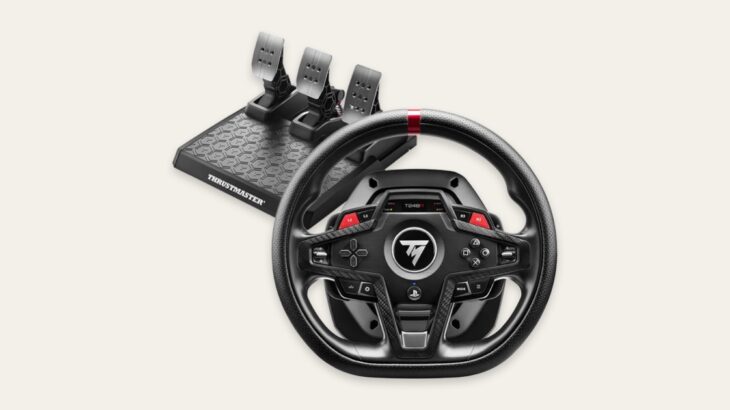
Released in 2025, the T598 is Thrustmaster’s first direct-drive racing wheel. For T-GT II users, it is a realistic upgrade path.
The T598’s force feedback is more finely detailed than the TGT2’s. The torque builds smoothly, direction changes around center are smooth, and the stages of force as force feedback switches from left to right—as well as the lack of rattling at the moment of transition—made the overall force feedback feel extremely smooth and high quality. …The T598 has a feel close to the G923 (Logitech’s belt-drive racing wheel), but with a further level of directness and vibration transmission. In particular, the transition between understeer and oversteer is extremely easy to understand, with the good feel you expect from direct drive (DD).
— From Picar Channel’s “[GT7] Official T598 Support: What I Found When Testing the Vehicle Behavior”
My assessment is that moving from the T-GT II gives you the evolution from belt drive to DD, plus finer detail beyond the TGT2. There is an important practical caveat, however: using an existing T-GT II steering wheel on the T598 requires a conversion adapter, which was not yet released domestically at the time of writing.
Who It Is—and Isn’t—for
✅ Recommended For
- Drivers whose main titles are GT7 / GT Sport and who prioritize time-attack results
- Drivers who value the fun of a game over ultimate real-car realism
- Drivers who prefer nimble, intuitive controls
- Drivers looking for the reassurance of a product developed through an official Polyphony Digital partnership
- Drivers who want pedals capable of linear fore-aft weight-transfer control
❌ Not Recommended For
- Drivers primarily focused on serious PC sims such as iRacing / ACC / rFactor 2 → CSL DD / DD Pro
- Drivers seeking a firm control feel like that of a real racing car → Fanatec DD Pro / DD1 + V3 pedals
- Drivers who put overwhelming torque and response first → DD1 / DD Extreme
- Existing T-GT II owners considering a replacement → consider moving to the T598 (the evolution to DD)
Related Videos
- [Gran Turismo 7] The surprising result of comparing the fastest racing wheels in a National Sports Festival time attack
- Which Is the Latest and Strongest Racing Wheel? T-GT2 vs DDPRO on PlayStation 5
- [GT7] The Final Racing Wheel Showdown Before Launch: This Is the Strongest Wheel
- [GT7] Driving Every Car in Update 1.55!
- [GT7] Official T598 Support: What I Found When Testing the Vehicle Behavior
Frequently Asked Questions
Q1. Which is faster: the T-GT II or DD Pro?
A. For GT7 / GT Sport, the T-GT II has been judged to make it easier to set faster times. In my direct DD1 time-attack comparison—the DD Pro’s higher-end counterpart—the T-GT II recorded 19.6 seconds against the DD1’s 20.4 seconds, comfortably ahead. Direct-drive racing wheels win on real-car feel and force feedback detail, but the T-GT II is better suited to the goal of simply driving faster.
Q2. Why can a belt-drive wheel be faster than DD?
A. The lightness of the wheel and pedals enables intuitive inputs, while the pedals’ linear fore-aft weight-transfer control improves braking precision. Its design philosophy also pairs well with GT7’s physics, including its distinctive behavior where sliding can be faster. The product’s development through a partnership with Polyphony Digital is part of that background.
Q3. Can I use it for PC sims such as iRacing / ACC?
A. You can, but the T-GT II shows its true strengths in Gran Turismo titles. If serious PC sims are your main focus, a direct-drive CSL DD / DD Pro has the stronger fundamental feel.
Q4. Should I choose the T598 or T-GT II?
A. If you are buying new, the T598 is worth considering as an evolution to DD. The T-GT II remains a strong option for existing users, but new buyers should compare its price and compatibility against the T598 before deciding.
Q5. Should I replace the included pedals with load-cell pedals?
A. If your goal is setting GT7 times, the included pedals may be enough. A load-cell setup could lose the advantage of linear fore-aft weight-transfer control. Especially with physics like GT7’s, some drivers may find potentiometer pedals easier to operate with a controller-like feel—and, as a result, easier to set times with. If you move into serious sims such as iRacing, then consider a separate load-cell upgrade.